Campbell cooking sauces stopped meaning one thing in June 2026. There are now two separate products fighting over the same name: the legacy 11 oz shelf-stable pouch you may already have in a cupboard, and a brand-new 10.5 oz condensed can that The Campbell’s Company put on shelves that month. They share a brand, they share a use case, and almost nothing else. The pouch lives in the sauce aisle and is ready to pour. The can lives in the soup aisle, is labeled “Condensed Sauces,” and needs water and a protein to become dinner. If you searched this term expecting one answer, that is why the results feel scrambled.
So this guide splits the two lines cleanly, then serves both: the exact cooking ratios, the simmer times that differ by flavor, the sodium and allergen numbers Campbell’s spreads across four separate pages, and a substitution map for the pouch flavors that have gone scarce at retail.
Quick answer: Campbell cooking sauces refer to two lines. The legacy line is an 11 oz ready-to-use pouch (Creamy Parmesan, Scampi, Savory Marsala, Sesame Garlic, Sweet and Sour) built for skillet, oven, slow cooker or multicooker in about 30 minutes. The 2026 line is a 10.5 oz condensed can (Smothered Chicken, Creamy Lemon Garlic, Butter Chicken, Thai Curry) sold in the soup aisle. The can method is one can plus 1 1/4 lb protein plus 1/2 cup water, ready in 20 minutes or less, serving four.
Pouch Versus Can: The Two Products Hiding Behind One Name
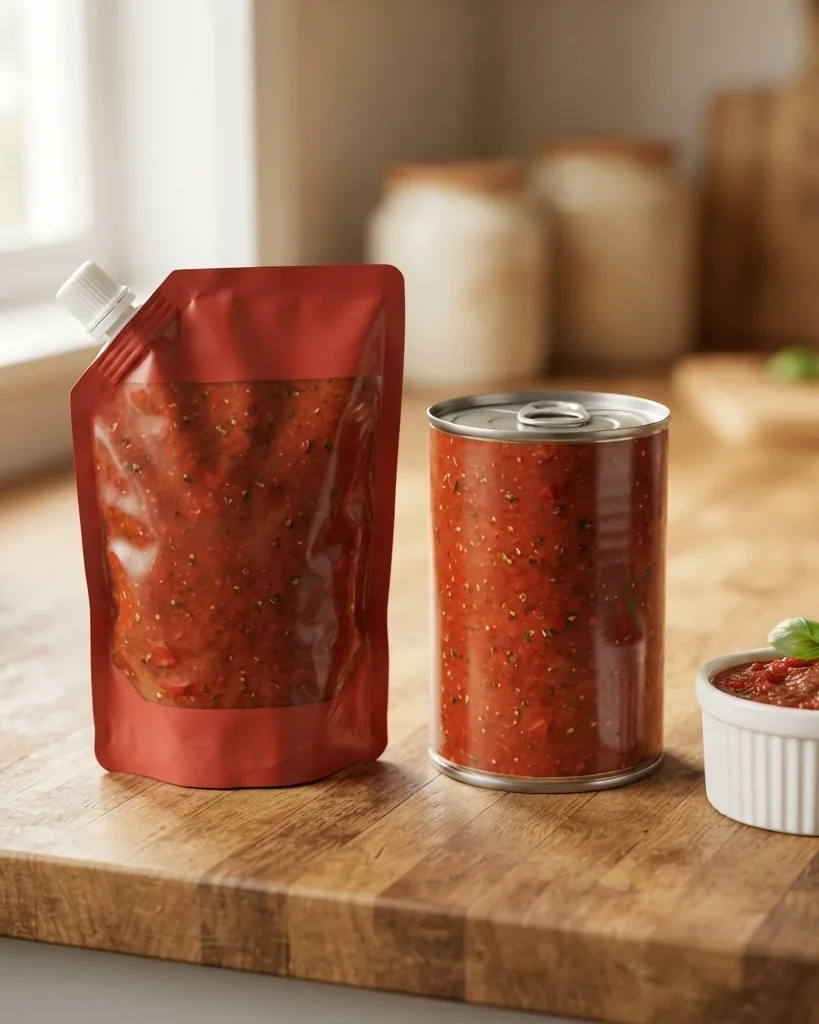
The fastest way to know which product you are dealing with is size and aisle. The legacy Campbell’s Cooking Sauces are 11 oz plastic pouches, ready to pour, stocked with the pasta sauces and marinades. The 2026 release is a 10.5 oz can labeled Condensed Sauces, and Campbell’s merchandises it in the soup aisle instead. One is ready to use straight from the package. The other is concentrated and has to be diluted and cooked with a protein before it becomes a meal. That half-ounce difference in stated weight, 11 oz versus 10.5 oz, is a reliable tell at the store.
The functional gap matters more than the name. The pouch is written for four cooking methods: skillet, oven, slow cooker and multicooker, targeting a 30-minute meal. The can is written for the skillet and promises a meal in 20 minutes or less. If you want the full brand-side breakdown, our Campbell’s cooking sauces honest guide walks through each format from a sauce maker’s angle.
- Legacy pouch: 11 oz, ready-to-use, sauce aisle, 4+ servings, four cooking methods, roughly 30 minutes.
- 2026 can: 10.5 oz, condensed, soup aisle, serves four, skillet-first, 20 minutes or less.
Why Campbell’s Put A Sauce In The Soup Aisle On Purpose
Campbell’s landed the can in the soup aisle because the whole product grew out of soup behavior. For decades people have used cream-of-mushroom and cream-of-chicken cans as an ingredient, not a meal, and the company built the launch on that habit. The condensed sauce is essentially that behavior formalized into four dinner-ready flavors. Placing it beside the soups it descends from is a merchandising decision that puts the new product where its buyers already reach.
The timing was deliberate. Food Dive reported the line was announced on 19 March 2026 for a June 2026 release, with four flavors: butter chicken, Thai curry, creamy lemon garlic and smothered chicken. In that coverage, Campbell’s CEO Mick Beekhuizen described the company as 157 years old as of March 2026 and said soup-as-an-ingredient is a growing part of the portfolio while soup-as-a-meal is declining. The math on the category backs the bet: Food Dive cited projections that the at-home condiment and sauce category will exceed $41 billion in sales by 2030, with roughly 80 percent of Americans using condiments, dips or sauces every week, heaviest among Gen Z and consumers in the South. A separate Wakefield Research survey with HelloFresh found 93 percent of Americans expect to cook as much as or more than last year over the next 12 months, and 52 percent lean on social media for meal ideas.
The Two-Step Method And The Ratios That Actually Matter
The canned line runs on one ratio: one 10.5 oz can plus 1 1/4 lb protein plus 1/2 cup water, with 1 tablespoon of oil, serving four. For Butter Chicken, Campbell’s specifies cubed boneless chicken breast served over 2 cups cooked white rice, with a 5-minute simmer once the sauce goes in. That is the whole skeleton. The word “condensed” is the part people miss: the sauce arrives concentrated, and the 1/2 cup of water is not optional garnish, it is the dilution step that turns paste into a coating sauce. Skip the water and you get something gluey that scorches.
Simmer time is not uniform, and the difference is not arbitrary. At the same ratio, Thai Curry simmers 5 minutes, Creamy Lemon Garlic runs 5 to 8 minutes, and Smothered Chicken needs a full 10 minutes because its recipe uses bone-in-weight thighs rather than quick-cooking breast cubes. Thighs carry more connective tissue and take longer to reach a safe, tender finish, so the longer simmer is doing real work, not padding the clock.
Scaling is straightforward once you treat the can as the unit. For two people, halve everything: half a can is awkward, so many cooks make the full batch and refrigerate half. For six, use one and a half cans with a scant 3/4 cup water and just under 2 lb of protein. For eight, double it: two cans, 2 1/2 lb protein, 1 cup water. The ratio holds; only the pan size changes. Crowd a skillet and the protein steams instead of searing, so step up to a wide pan or work in two batches. If you want a from-scratch counterpoint to the shortcut, our homemade teriyaki sauce technique shows how the same simmer-and-coat logic works without a can.
Protein swaps change the timing, not the ratio. Boneless breast cubes cook fastest. Thighs need the extra minutes Smothered Chicken already builds in. Shrimp goes in near the very end and is done in a few minutes. Firm tofu wants a pre-sear so it holds up in the sauce. Pork is the one swap with a food-safety consequence, covered below. If the sauce tightens too far during the simmer, loosen it with a splash of water or stock; if it is thin, hold it at a bare simmer a minute or two longer to reduce. If a cream-based flavor looks like it is breaking, pull the pan off the heat and stir hard off the burner rather than boiling it harder.
Verify 165 Degrees, Because Color And The Clock Both Lie
The single most important number in this whole guide is a temperature, not a time. The USDA Food Safety and Inspection Service recommends cooking all poultry, whole birds, pieces and ground, to a safe minimum internal temperature of 165 degrees Fahrenheit, checked with a food thermometer in the thickest part and away from bone. A 5-minute simmer is a starting point calibrated to a specific cut and cube size, not a guarantee. Change the cut, crowd the pan, or start with cold chicken and that timing drifts. The thermometer is the only thing that actually tells you the bird is safe.
Here is the uncomfortable part. FSIS reports that in the FSIS/FDA Food Safety Survey only 10 percent of home cooks use a food thermometer for chicken breasts, and only 6 percent for hamburgers. Most people are judging doneness by color or by the packet time, both of which can be wrong in opposite directions. You can check the FSIS chicken guidance yourself at the USDA chicken from farm to table page.
The swap that trips people up is pork. If you sub pork for chicken in any of these sauces, the target changes: FSIS recommends 145 degrees Fahrenheit plus a 3-minute rest for whole-muscle beef, pork, lamb and veal. That rest is part of the safety math, not a serving suggestion. Cook pork to the poultry number out of habit and you get a dry, overcooked result; cook chicken to the pork number and you undercook it. Match the temperature to the protein, every time.
Sodium, Sugar And The Three Allergens Every Can Declares
Every one of the four new flavors clusters tightly on sodium and splits mainly on sugar, and Campbell’s never shows them side by side. Across the line, sodium sits at 390 to 400 mg per 1/4 cup serving, all landing at 17 percent of the Daily Value. The real differentiator between flavors is added sugar: Smothered Chicken has 0 g, while Butter Chicken carries 3 g of added sugars. Calories are low per serving because the serving is small, which is the catch buyers should understand before trusting the front of the panel.
Here is the consolidated view Campbell’s splits across four product pages:
- Butter Chicken: 70 calories, 3 g fat, 390 mg sodium (17% DV), 9 g carbohydrate, 6 g total sugars incl. 3 g added, 1 g protein per 1/4 cup. Contains Wheat, Milk.
- Thai Curry: 60 calories, 3 g fat (1 g saturated), 400 mg sodium (17% DV), 7 g carbohydrate, 3 g sugars incl. 2 g added. Contains Wheat, Milk. Built on yellow curry paste with lemongrass, shallots, lime peel and turmeric.
- Smothered Chicken: 50 calories, 3.5 g fat, 390 mg sodium (17% DV), 5 g carbohydrate, 1 g sugars, 0 g added. Contains Wheat, Milk, Soy. First ingredient is chicken stock.
Read the serving size honestly. The panel serving is 1/4 cup (60 mL) of sauce, not a plated portion. One 10.5 oz can runs about 5 label servings, and the recipe serves four, so each plate carries roughly 1.25 label servings of sauce. Multiply 390 mg by 1.25 and a Butter Chicken plate carries about 490 mg of sodium from the sauce alone, before you salt the rice or season the protein. That is the number a shopper managing blood pressure actually needs, and no retail listing prints it.
On allergens, the answer to “are they gluten free” is a flat no. All four new SKUs list wheat flour and declare Contains Wheat, so they are not gluten free. All four contain milk, so they are not dairy free either. Smothered Chicken adds soy on top. Under US law, nine substances are defined as major food allergens that must be declared: milk, egg, fish, Crustacean shellfish, tree nuts, wheat, peanuts, soybeans and sesame. Three of those nine appear on these labels, which is exactly why the “Contains” line is legally meaningful and worth reading. The FDA explains how to read that line on its have food allergies, read the label update.
The sodium context is bigger than one can. The FDA’s draft Phase II sodium guidance, issued 15 August 2024, sets three-year voluntary targets across 163 food categories; full compliance would bring average US intake to roughly 2,750 mg per day, and Phase I plus Phase II together would cut average sodium intake by about 20 percent. The comment period closed 13 January 2025 under Docket No. FDA-2014-D-0055. A can at 390 to 400 mg per quarter cup sits inside a category the agency is actively steering downward. If you cook for someone watching salt, the from-scratch route in our juicy salmon marinade for grill or oven gives you control the can cannot.
The Pouch Line Is Scarce: Your Substitution Map
The legacy 11 oz pouches are patchy at retail, with several SKUs listed out of stock at major sellers, and no incumbent page tells you what to reach for instead. The pouch flavors were Creamy Parmesan, Classic or Shrimp Scampi, Savory Marsala, Sesame Garlic and Tangy Sweet and Sour, each a ready-to-use sauce making 4+ servings across skillet, oven, slow cooker and multicooker. If your favorite is gone, the new can is the closest brand-side landing spot for two of them, though the method changes from pour-and-simmer to dilute-and-simmer.
The pouches carried real recipes worth preserving even if the sauce disappears. The Classic Scampi pouch built a dish from 8 oz uncooked linguine, 1 lb extra-large peeled and deveined shrimp, 1 tablespoon vegetable oil, one pouch, 1 tablespoon lemon juice and 2 tablespoons grated Parmesan, four servings. Creamy Parmesan turned into a 30-minute chicken carbonara with 8 oz spaghetti, 1 1/4 lb boneless chicken, 1 cup frozen peas, 4 slices cooked bacon and 1/4 cup shredded Parmesan. Savory Marsala led with marsala wine, then mushrooms, water, tomato puree and butter, declared Contains Milk, Soy, and paired with 1 1/4 lb chicken, 2 1/2 cups sliced baby bella mushrooms and 8 oz rotini.
Rough substitution logic: a scarce Creamy Parmesan pouch maps toward the Creamy Lemon Garlic can if you want a bright cream sauce, though you lose the straight parmesan note. A Marsala or Scampi fan will not find a direct can replacement in the four-flavor lineup and is better off scratch-building. For the cream base itself, our silky dairy-free cashew cream stands in for the parmesan pouch texture without the milk allergen.
Can Versus Cream-Of Soup Versus Scratch: What You Trade
The condensed can competes directly with the cream-of-soup hack it was born from, and the trade is convenience for control. A cream-of-mushroom or cream-of-chicken can gives you a blank, savory base you season yourself. The new sauce gives you a finished flavor profile, butter chicken or Thai curry, that you would otherwise have to build from a spice pantry. If you already keep curry paste, coconut and aromatics, the can buys you little. If you do not, it collapses a shopping list into one purchase.
- Cream-of soup as sauce: cheapest, most flexible, requires your own seasoning and often your own dairy to loosen.
- Condensed sauce can: one purchase, fixed flavor, fixed 20-minute method, locked to wheat and milk.
- Scratch: most work, full control of sodium, sugar and allergens, no fixed profile.
Against jarred simmer sauces, the difference is dilution. Most jarred sauces are ready to use; the Campbell’s can is condensed and needs that 1/2 cup of water, which is why it reads as smaller on the shelf but stretches to serve four. On storage, treat both lines as pantry-stable until opened, then refrigerate leftovers promptly and use them within a few days like any cooked poultry dish. For a slow-simmer project that rewards patience over speed, our easy crock pot applesauce is a different lane entirely, but it shows how a long, low cook builds flavor the 20-minute can never will.
Frequently Asked Questions
Are Campbell’s cooking sauces discontinued?
Not officially, but the legacy 11 oz pouch line is scarce, with several SKUs listed out of stock at major retailers as of mid-2026. Separately, Campbell’s launched a new 10.5 oz condensed can line in June 2026 with four flavors. So the name now covers two products at once: a fading pouch line and a fresh canned line sold in the soup aisle.
Are Campbell cooking sauces gluten free?
No. All four new canned flavors, Butter Chicken, Thai Curry, Smothered Chicken and Creamy Lemon Garlic, list wheat flour and carry a Contains Wheat declaration, so none is gluten free. All four also contain milk, ruling out dairy-free use, and Smothered Chicken adds soy. Under US law, wheat, milk and soy are all major allergens that must appear on the label.
Do you have to add water to the canned sauce?
Yes, the can is condensed, not ready to use. The official method adds 1/2 cup water per 10.5 oz can along with 1 1/4 lb of protein and 1 tablespoon of oil. Skipping the water leaves the sauce too thick to coat evenly and prone to scorching. The water is the dilution step that turns the concentrate into a proper skillet sauce serving four.
How much chicken per can?
The standard ratio is 1 1/4 lb of protein per 10.5 oz can, with 1/2 cup water, serving four. Butter Chicken specifies cubed boneless breast; Smothered Chicken uses thighs and a longer 10-minute simmer. Whatever the cut, verify 165 degrees Fahrenheit with a thermometer in the thickest part before serving, since color and packet timing are not reliable doneness signals.
How much sodium is in a serving?
Each 1/4 cup serving carries 390 to 400 mg of sodium, or 17 percent of the Daily Value, across all four new flavors. Because a plate uses roughly 1.25 label servings of sauce, a Butter Chicken plate carries about 490 mg from the sauce alone, before rice or added salt. That sits inside a category the FDA is steering toward a 2,750 mg per day population intake.
What aisle are the new canned sauces in?
The soup aisle, not the sauce aisle. Campbell’s built the condensed can line on the long-standing habit of using cream-of soups as a cooking ingredient, so it merchandises the new sauces beside the soups they descend from. The older 11 oz pouches, by contrast, sit with the pasta sauces. Aisle location is the quickest way to tell the two lines apart in a store.
Lab Notes
The bottom line: if you own a pouch, use it up on the classic pasta recipes while it lasts, and check 165 degrees no matter which line you cook. If you are buying the can, remember the water, match the simmer to the flavor, and read the Contains line before it hits the pan.